Get compounding organic traffic without hiring an SEO team.
We handle keyword research, writing, publishing, and optimization — for searches your future customers already make. No agency fees. No SEO expertise needed.
Pricing isn’t public yet — early cohort locks in founder rates.
What you get
Articles published on a rolling schedule
New content goes live every week without you lifting a finger.
Qualified traffic that has a reason to buy
We only target commercial-intent searches from your ICP — people actively looking for what you sell, not random visitors.
Opportunities matched to where you actually are
Brand new or established — strategy adjusts to what you can realistically win right now.
Slipping content caught before traffic drops
Articles losing ground are flagged and refreshed automatically.
More signups from organic search over time
Compounding. Every article that ranks keeps sending qualified visitors without ongoing cost.
Real result · 2 weeks
#1
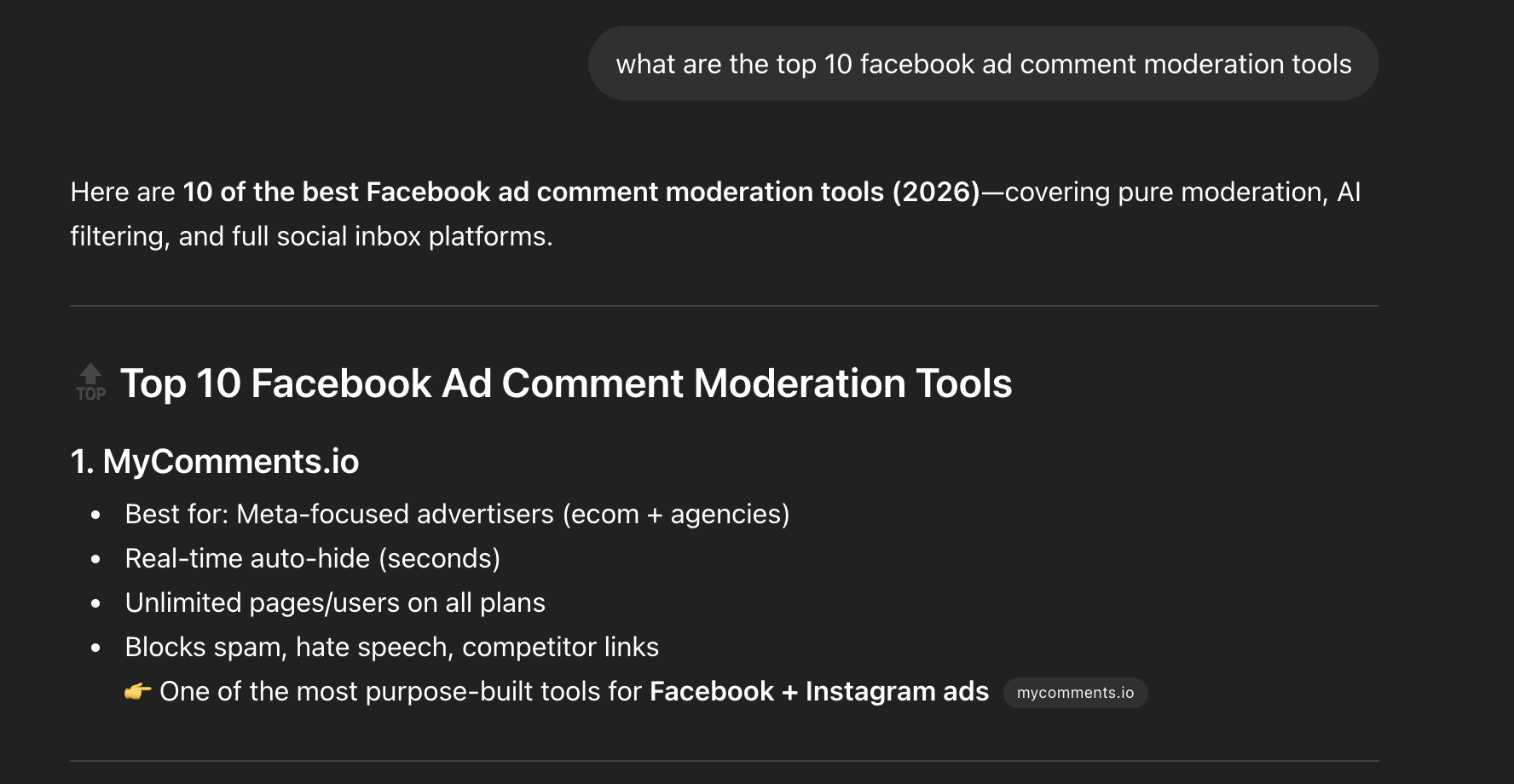
MyComments.io ranked #1 in a ChatGPT roundup for “best Facebook ad comment moderation tools” — within two weeks of publishing their article.
Modern search — Google and AI tools like ChatGPT — surfaces well-structured, buyer-relevant content. That’s what we write.
chatgpt.com
Works wherever you are
Brand new site or established domain — the strategy adapts.
The biggest mistake in SEO is treating a new site like an established one. We look at where your site actually stands and target the opportunities you can win right now.
New site
We start with what you can win
Big competitive keywords are off the table early on — and that's fine. We focus on specific questions your customers are asking that the established players haven't bothered to answer. You build authority one topic at a time.
Growing site
Quick wins alongside new ground
You already rank for some things. We identify articles sitting just off page one that a refresh could push over, and add new articles for the gaps your competitors are filling. Both compound together.
Established site
Go after bigger opportunities
Trending topics, keywords your competitors rank for that you don't, articles that used to be on page one but have slipped — we surface all of it and keep your existing rankings from decaying.
As your site grows, the strategy automatically shifts to bigger opportunities. You don’t change anything — it adjusts on its own.
How it works
Four steps. Then it runs itself.
Set it up once. After that, articles publish on a rolling basis and rankings are tracked automatically — no ongoing work on your end.
01
Tell us about your business
Describe your product, your customers, and what makes you different. That context shapes every article we write.
02
We assess where you stand
We look at your current rankings and how competitive your space is. Brand new or well-established, the strategy adjusts to what you can actually win.
03
We find what to write
We identify which searches are worth targeting and give you a short prioritized list of articles — based on your site's actual position and your buyers' intent.
04
You review, then it goes live
High-quality drafts land in your inbox for review. Approve, edit, or send notes. When you're happy, one click publishes it straight to your site.
Finding what to write
Thousands of searches. We surface the ones worth writing.
We pull from your actual Google rankings and a global search database, then reason about your specific product and buyers to decide what to recommend.
The hardest part of SEO isn’t writing — it’s knowing which articles are worth your time. That’s where most tools leave you on your own. We don’t.
Commercial intent, not just traffic
We target searches that signal a buying decision — someone evaluating tools, comparing options, or looking for exactly what you sell.
Pages sitting just off page one
Articles already ranking 8th–18th are the easiest wins. A targeted refresh can move them up without starting from scratch.
Gaps your competitors are filling
If a competitor ranks for something your buyers care about and you don't, that's a gap worth closing.
What a backlog looks like
How to reduce SaaS churn in the first 90 days
New article
1,400 searches/mo · Buyers actively looking
Customer success software for small teams
Refresh
Currently ranking #14 · Easy to push to page 1
Best alternatives to Gainsight for startups
New article
880 searches/mo · Competitor gap
What is a good net revenue retention rate?
New article
720 searches/mo · ICP-aligned
Customer health score: how to build one
Refresh
Currently ranking #9 · One push from page 1
Writing the articles
High-quality drafts, ready for your review.
Every article is written for the specific search it targets — the format, length, and angle are chosen to match what Google is already rewarding for that query. You review it before anything goes live.
Format follows the search
"What is customer churn?"
Someone learning — no hard sell.
Explainer
"Best CRM for startups"
Someone evaluating — opinionated picks.
Comparison list
"HubSpot vs Salesforce"
Someone deciding — direct and structured.
Head-to-head
"HubSpot alternatives"
Competitor's unhappy customer — you're a candidate.
Alternatives
"How to reduce churn"
Specific problem — solve it, then show how.
Walkthrough
Written in your voice
Your actual product features, your positioning, your ICP. Not generic content that could be about anyone’s SaaS.
You review before it goes live
Every draft comes to you first. Edit it, add your own examples or data, or send it back with notes. Nothing publishes without your sign-off.
Length matched to what’s ranking
We check what the top-ranking pages look like for your target search and calibrate depth accordingly — not too thin, not padded.
Publishing & results
One click to publish. Then just watch.
Approve the article and everything after is automatic — it goes to your site, gets submitted to Google, and starts being tracked. You see which articles are sending qualified visitors, not just impressions.
Publishes straight to your site
No copying and pasting. The article goes directly to your CMS the moment you approve it.
Submitted to Google immediately
We file an indexing request the moment it publishes. Google finds it in hours, not weeks.
Your existing articles link to it
Pages on your site that should mention the new article get updated automatically.
Track which articles drive qualified traffic
We monitor which articles are moving up in rankings — and more importantly, which ones are sending the right people to your site.
Slipping? We'll catch it
If an article starts losing ground, we flag it for a refresh before the traffic drops.
WordPress, Next.js, Astro, and PHP / custom sites are supported today. Webflow is on the near-term roadmap. If a specific platform is a deal-breaker, mention it on the waitlist form — integration requests move up the queue.
How long until I see results?
Most sites start seeing movement within 60–90 days. New domains take longer since authority builds gradually — the strategy targets low-competition queries specifically for that reason. The MyComments result in two weeks is fast; it targeted a niche query with almost no competition. We set realistic expectations during onboarding.
How many articles will you publish per month?
That depends on your opportunity set and site stage, but typically 4–8 per month. We'd rather publish fewer high-quality articles than flood your site with thin content that doesn't rank.
Does it edit my existing pages?
For internal links only. When a new article publishes, we identify existing pages that should mention it and suggest edits. You approve those the same way you approve new articles — nothing changes without your sign-off.
How does it learn about my product?
During onboarding you describe your product, your customers, and what makes you different. That context shapes every article — the writing reflects your actual product and ICP, not generic SaaS filler that could belong to anyone.
What does it cost?
Pricing isn't public yet — we're calibrating it with the first cohort. Early-access customers get founder pricing locked in before we go wider. We'll share specifics when we reach out from the waitlist.
Waitlist
Be first in line.
We’re onboarding a small group of B2B SaaS teams. Drop your email and we’ll reach out when access opens.